
SSD-GS: Scattering and Shadow Decomposition for Relightable 3D Gaussian Splatting
Abstract
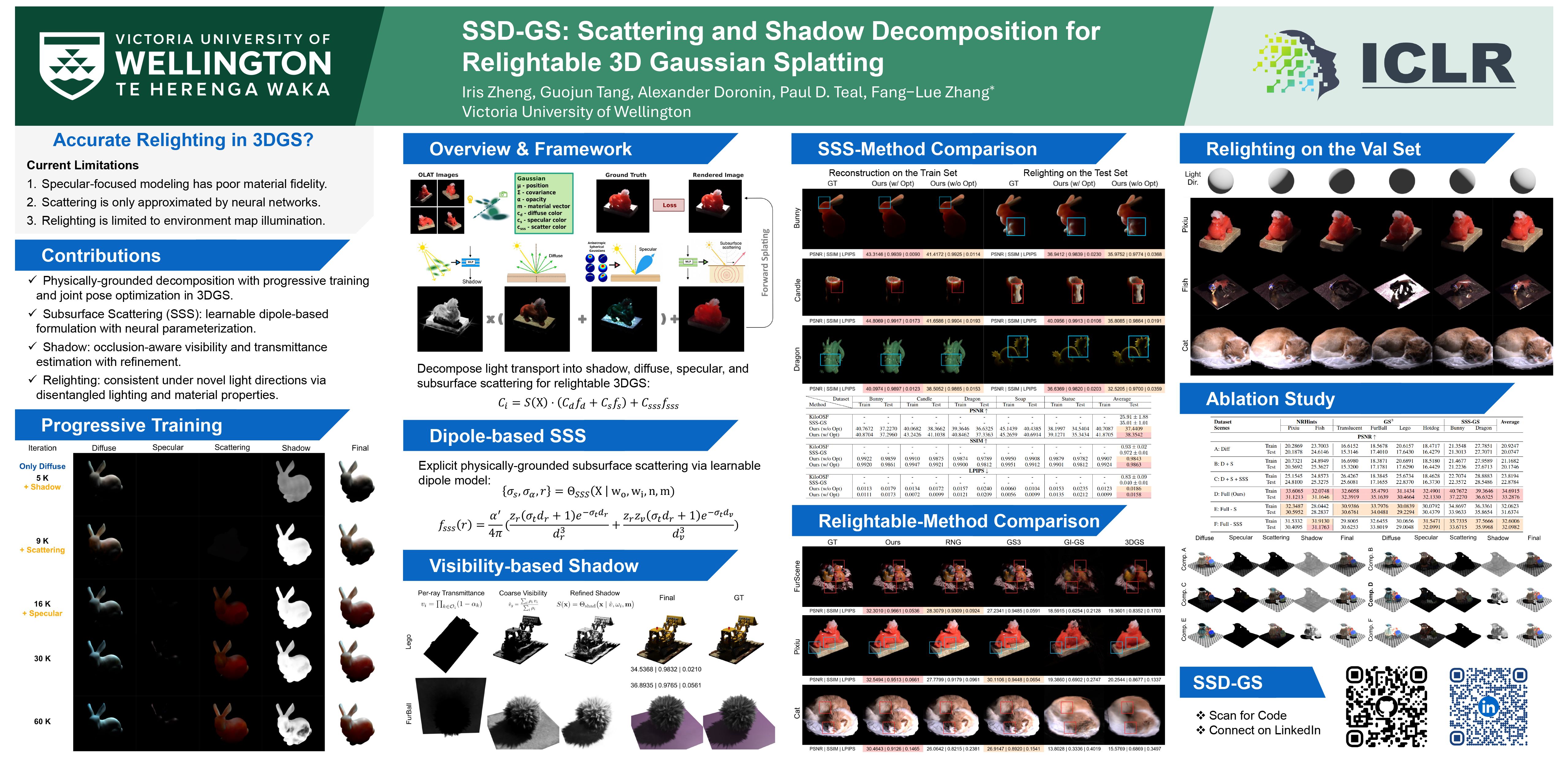
We present SSD-GS, a physically-based relighting framework built upon 3D Gaussian Splatting (3DGS) that achieves high-quality reconstruction and photorealistic relighting under novel lighting conditions. In physically-based relighting, accurately modeling light-material interactions is essential for faithful appearance reproduction. However, existing 3DGS-based relighting methods adopt coarse shading decompositions, either modeling only diffuse and specular reflections or relying on neural networks to approximate shadows and scattering. This leads to limited fidelity and poor physical interpretability, particularly for anisotropic metals and translucent materials. To address these limitations, SSD-GS decomposes reflectance into four components: diffuse, specular, shadow, and subsurface scattering. We introduce a learnable dipole-based scattering module for subsurface transport, an occlusion-aware shadow formulation that integrates visibility estimates with a refinement network, and an enhanced specular component with an anisotropic Fresnel-based model. Through progressive integration of all components during training, SSD-GS effectively disentangles lighting and material properties, even for unseen illumination conditions, as demonstrated on the challenging OLAT dataset. Experiments demonstrate superior quantitative and perceptual relighting quality compared to prior methods and pave the way for downstream tasks including controllable light source editing and interactive scene relighting. The source code is available at: https://github.com/irisfreesiri/SSD-GS.