
LaTo: Landmark-tokenized Diffusion Transformer for Fine-grained Human Face Editing
Abstract
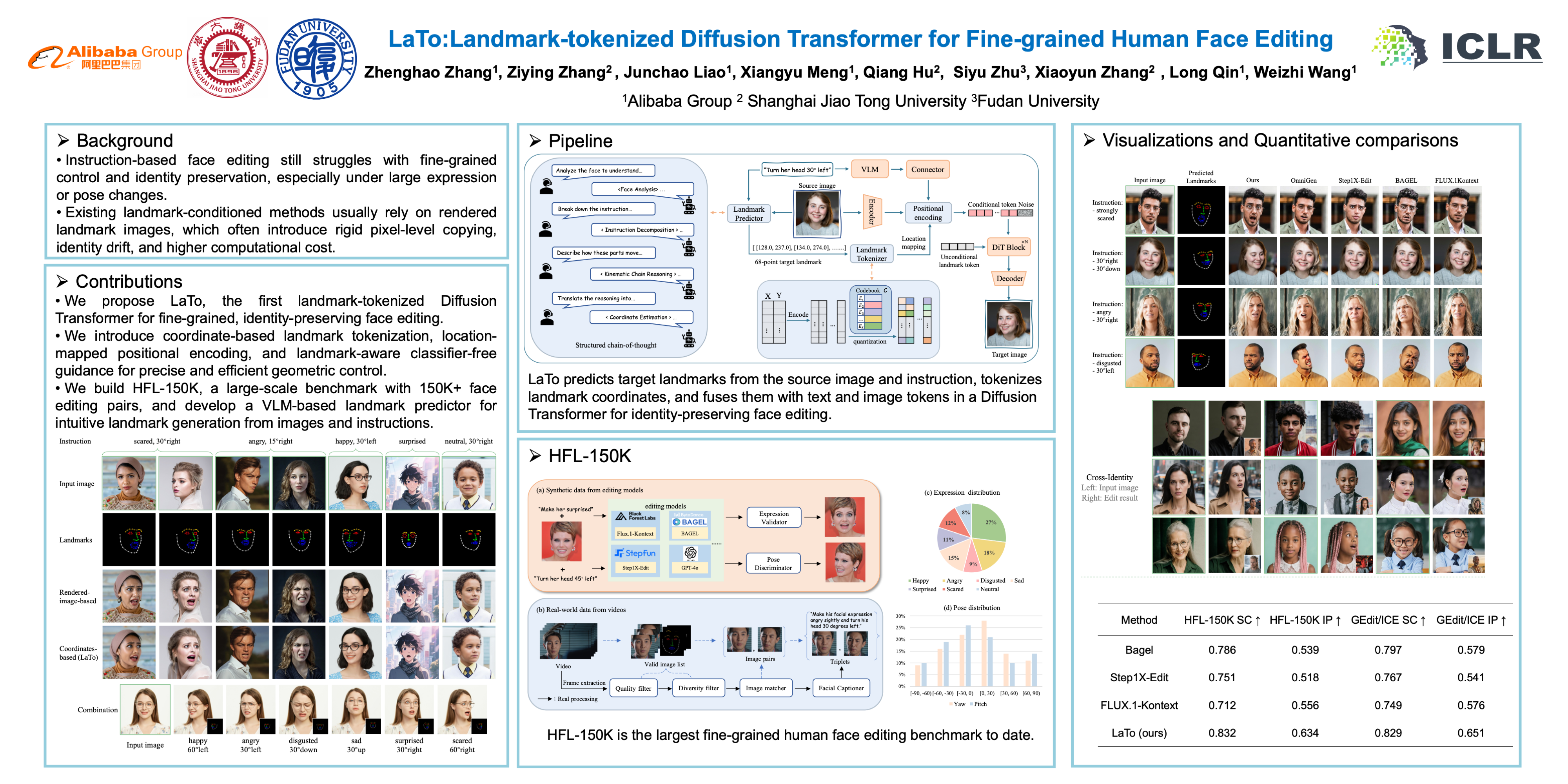
Recent multimodal models for instruction-based face editing enable semantic manipulation but still struggle with precise attribute control and identity preservation. Structural facial representations such as landmarks are effective for intermediate supervision, yet most existing methods treat them as rigid geometric constraints, which can degrade identity when conditional landmarks deviate significantly from the source (e.g., large expression or pose changes, inaccurate landmark estimates). To address these limitations, we propose LaTo, a landmark-tokenized diffusion transformer for fine-grained, identity-preserving face editing. Our key innovations include: (1) a landmark tokenizer that directly quantizes raw landmark coordinates into discrete facial tokens, obviating the need for dense pixel-wise correspondence; (2) a location-mapped positional encoding and a landmark-aware classifier-free guidance that jointly facilitate flexible yet decoupled interactions among instruction, geometry, and appearance, enabling strong identity preservation; and (3) a landmark predictor that leverages vision–language models to infer target landmarks from instructions and source images, whose structured chain-of-thought improves estimation accuracy and interactive control. To mitigate data scarcity, we curate HFL-150K, to our knowledge the largest benchmark for this task, containing over 150K real face pairs with fine-grained instructions. Extensive experiments show that LaTo outperforms state-of-the-art methods by 7.8% in identity preservation and 4.6% in semantic consistency. Code is available at https://github.com/alibaba/landmark-tokenized-dit.