
Sample Lottery: Unsupervised Discovery of Critical Instances for LLM Reasoning
Abstract
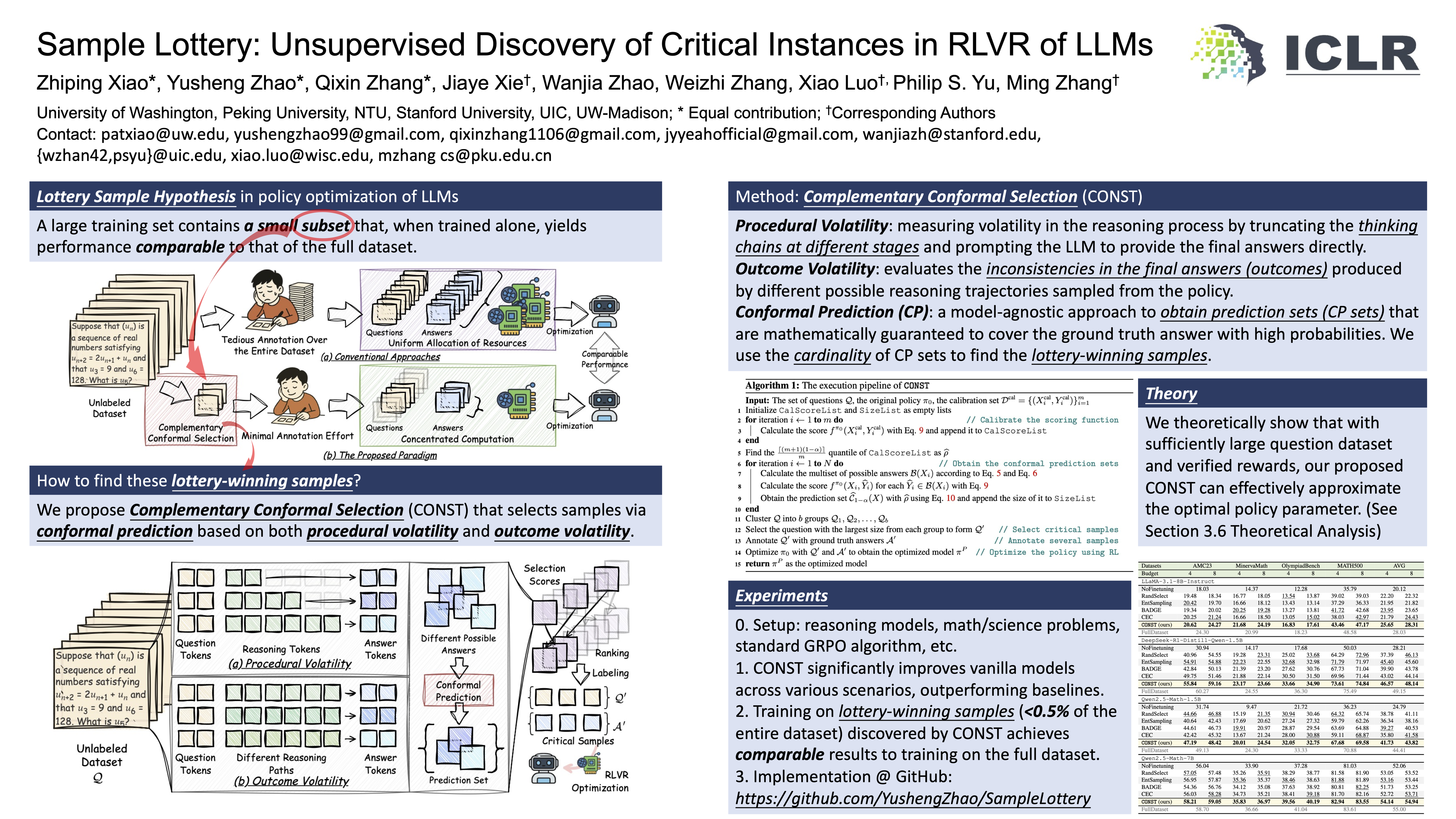
Reinforcement Learning with Verifiable Reward (RLVR) has equipped large language models (LLMs) with the capability of reasoning over complicated logical problems through policy optimization. However, conventional methods require complete annotation of the entire dataset and allocate computation uniformly over all samples. We articulate the lottery sample hypothesis in policy optimization of LLMs: a large training set contains a small subset that, when trained alone, yields performance comparable to that of the full dataset. This paper therefore explores the following question: How can we identify these lottery-winning samples from the original dataset without access to answers? Unlike prior efforts that analyze the effect of different samples in the training set with complete annotation, this paper focuses on the unsupervised discovery of critical instances for LLM reasoning and proposes a novel framework termed Complementary Conformal Selection (CONST). Specifically, CONST evaluates the importance of samples by considering two complementary components: procedural volatility and outcome volatility. Procedural volatility measures the potential variations during the LLM’s reasoning process, while outcome volatility captures inconsistencies in the final answer. Subsequently, conformal prediction is used to obtain a prediction set whose cardinality serves as the criterion for selecting the lottery-winning samples for annotation. We also provide a theoretical analysis, showing that CONST can effectively approximate the optimal policy. Extensive experiments on various LLMs across different datasets demonstrate the effectiveness of CONST.