
Generalization of Diffusion Models Arises with a Balanced Representation Space
Abstract
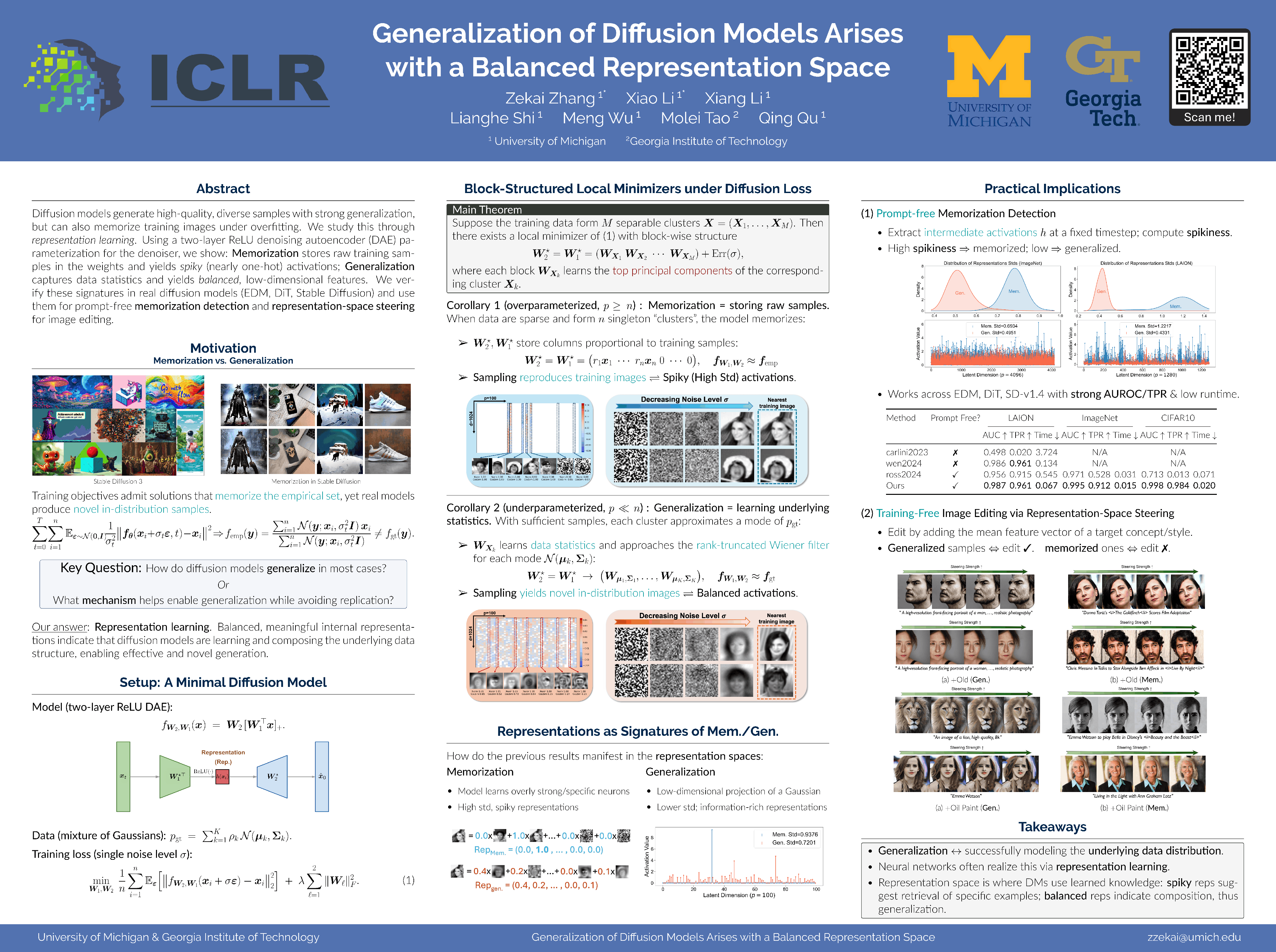
Diffusion models excel at generating high-quality, diverse samples, yet they risk memorizing training data when overfit to the training objective. We analyze the distinctions between memorization and generalization in diffusion models through the lens of representation learning. By investigating a two-layer ReLU denoising autoencoder (DAE), we prove that: (i) memorization corresponds to the model storing raw training dataset in the learned weights for encoding and decoding, yielding localized, spiky representations; whereas (ii) generalization arises when the model captures local data statistics, producing balanced representations. Furthermore, we validate our theoretical findings on real-world unconditional and text-to-image diffusion models, demonstrating that the same representation structures emerge in deep generative models with significant practical implications. Building on these insights, we propose a representation-based method for detecting memorization and a training-free editing technique that allows precise control via representation steering. Together, our results highlight that learning good representations is central to novel and meaningful generative modelling. Code is available at https://github.com/la0ka1/diffusion-gen-from-rep.