
Tokenization to Transfer: Do Genomic Foundation Models Learn Good Representations?
Abstract
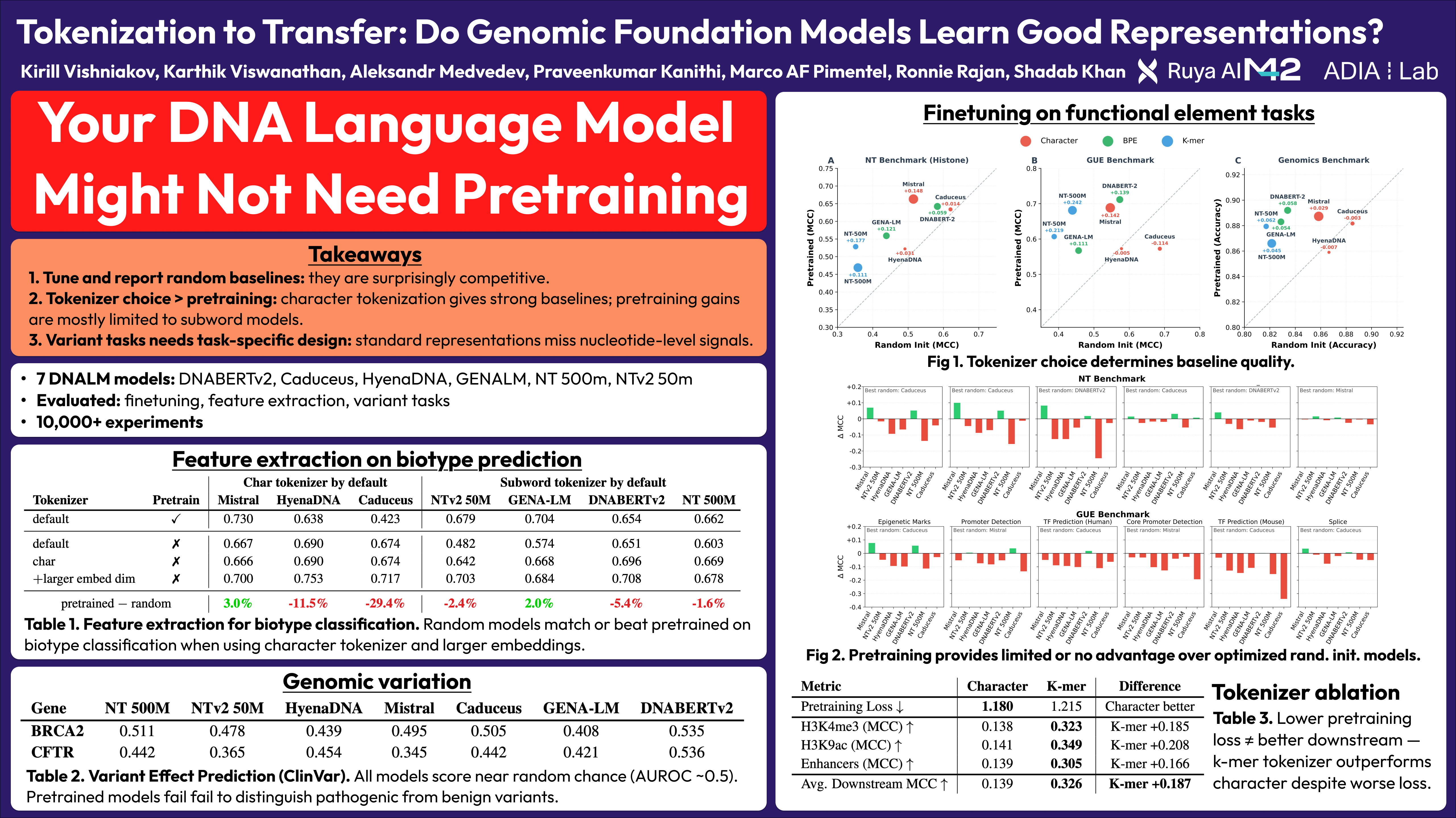
The success of Large Language Models has inspired the development of Genomic Foundation Models (GFMs) through similar pretraining techniques. However, the relationship between pretraining performance and effectiveness in downstream genomic tasks remains unclear. Additionally, the high computational cost of pretraining raises questions about its cost-efficiency. To assess the usefulness of pretraining in genomics, we evaluated seven different GFMs across 52 diverse genomic tasks, comparing them to their counterparts with randomly initialized weights. Across benchmarks, we find that randomly initialized models provide surprisingly strong baselines and tokenizer and architecture choices strongly shape both these baselines and the gains from pretraining. Specifically, character‑token models often match or exceed the performance of larger pretrained k‑mer or BPE models, whereas subword models appear to benefit from pretraining. We also find that the evaluated GFMs fail to capture clinically relevant genetic mutations, with embeddings and log‑likelihood ratios showing limited sensitivity to annotated variants. For the tasks we study, these results suggest that current NLP‑style pretraining strategies provide modest, tokenizer‑gated improvements over strong random baselines and motivate more biologically informed tokenization and variant‑aware objectives. Our code is available at https://github.com/m42-health/gfm-random-eval.