
Unveiling Downstream Performance Scaling of LLMs: A Clustering-Based Perspective
Abstract
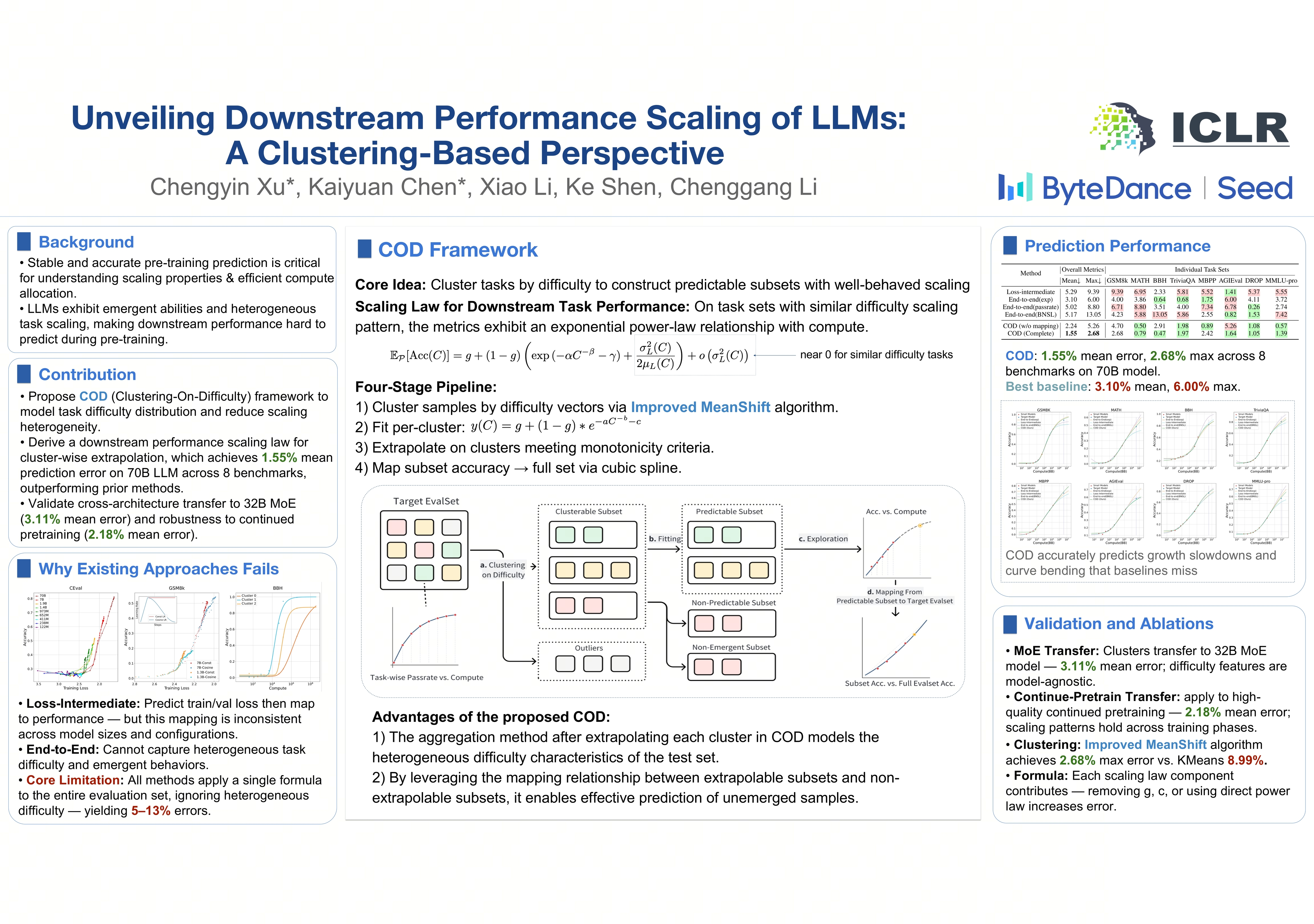
The escalating scale and cost of Large Language Models (LLMs) training necessitate accurate pre-training prediction of downstream task performance for comprehensive understanding of scaling properties. This is challenged by: 1) the emergence phenomenon, where unpredictable capabilities appearing suddenly at critical model scales; and 2) uneven task difficulty and inconsistent performance scaling patterns, leading to high metric variability. Current prediction methods lack accuracy and reliability. We propose a Clustering-On-Difficulty (COD) framework for downstream performance prediction. The COD framework clusters tasks by their difficulty scaling features, thereby constructing a more stable and predictable task subset that exhibits well-behaved scaling characteristics with the increase of compute budget. We adopt a performance scaling law to predict cluster-wise performance with theoretical support. Predictable subset performance acts as an intermediate predictor for the full evaluation set. We further derive a mapping function to accurately extrapolate the performance of the subset to the full set. Applied to an LLM with 70B parameters, COD achieved a 1.55\% average prediction error across eight key LLM benchmarks, thus providing actionable insights for scaling properties and training monitoring during LLM pre-training.