
BrowseNet: Graph-Based Associative Memory for Contextual Information Retrieval
Abstract
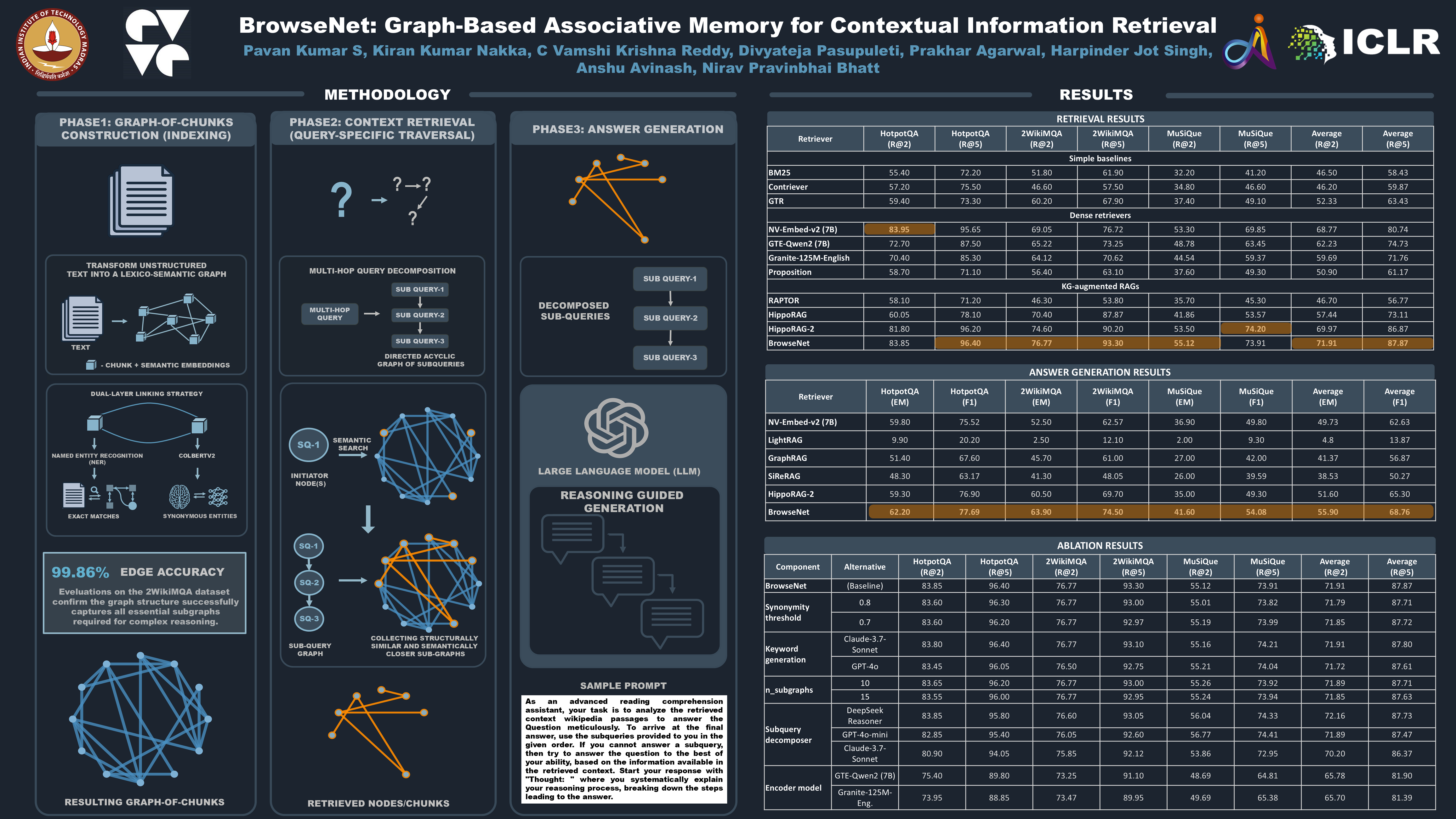
Associative memory systems face significant challenges in efficiently retrieving semantically related information from large document collections, particularly when queries require traversing complex relationships between concepts. Traditional retrieval-augmented generation (RAG) approaches often struggle to capture intricate associative patterns and relationships embedded within textual data. To address this limitation, we propose BrowseNet, a novel associative memory framework that leverages query-specific subgraph exploration within a named-entity-based graph for enhanced information retrieval. Our method transforms unstructured text into a graph-of-chunks representation, where nodes encode document chunks with semantic embeddings and edges capture lexical relationships between content segments. By dynamically traversing the graph-of-chunks based on query characteristics, BrowseNet emulates content-addressable memory systems that enable efficient pattern matching and associative recall. The framework incorporates both structural similarity derived from lexical relationships and semantic similarity based on embedding representations to optimize retrieval performance. We evaluate BrowseNet against established RAG baselines and state-of-the-art (SOTA) pipelines using publicly available datasets that require associative reasoning across multiple information sources. Experimental results demonstrate that BrowseNet achieves SOTA performance in exact match score over both the graph-based RAG approaches and the dense retrieval methods. The two-pronged approach combining structural graph traversal with semantic embeddings enables more effective associative memory retrieval, particularly for queries requiring the integration of disparate but related information. The code and datasets are open-sourced at: https://github.com/bisect-group/BrowseNet