
Trained on Tokens, Calibrated on Concepts: The Emergence of Semantic Calibration in LLMs
Preetum Nakkiran ⋅ Arwen Bradley ⋅ Adam Golinski ⋅ Eugene Ndiaye ⋅ Michael Kirchhof ⋅ Sinead Williamson
Abstract
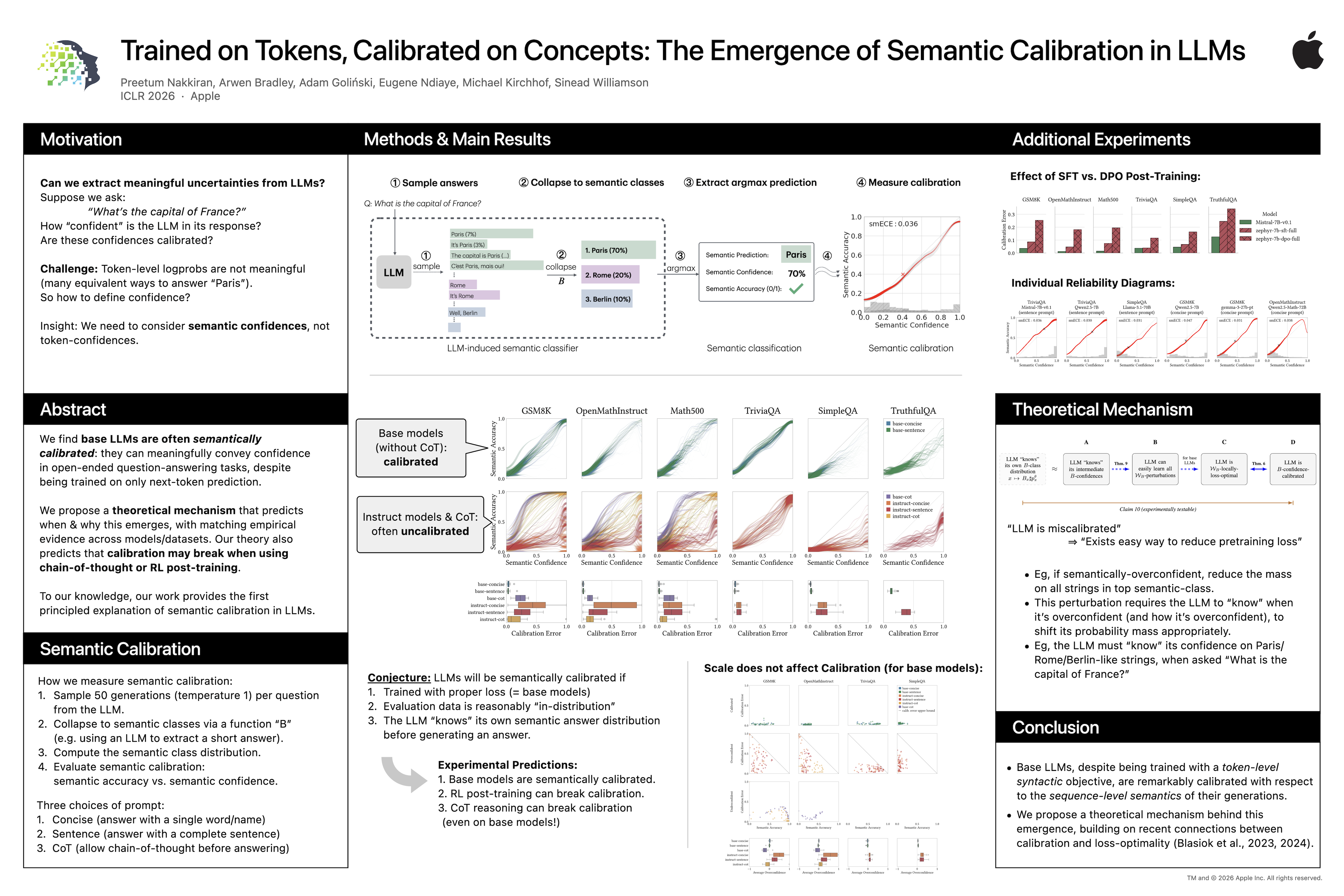
Large Language Models (LLMs) often lack meaningful confidence estimates for the semantic content of their outputs. While base LLMs are known to exhibit next-token calibration, it remains unclear whether they can assess confidence in the actual meaning of their responses beyond the token level. We find that, when using a certain sampling-based notion of semantic calibration, base LLMs are remarkably well-calibrated: they can meaningfully assess confidence in various open-ended question-answering tasks, despite training only on next-token prediction. To formalize this phenomenon, we introduce "$B$-calibration," a notion of calibration parameterized by the choice of equivalence classes. Our main theoretical contribution establishes a mechanism for why semantic calibration emerges in base LLMs, leveraging a recent connection between calibration and local loss optimality. This theoretical mechanism leads to a testable prediction: base LLMs will be semantically calibrated when they can easily predict their own distribution over semantic answer classes before generating a response. We state three implications of this prediction, which we validate through experiments: (1) Base LLMs are semantically calibrated across question-answering tasks, (2) instruction-tuning procedures systematically break this calibration, and (3) chain-of-thought reasoning breaks calibration (intuitively because models cannot predict their final answers before completing their generation). To our knowledge, our work provides the first principled explanation of when and why semantic calibration emerges in LLMs.
Video
Chat is not available.
Successful Page Load