
PALC: Preference Alignment via Logit Calibration
Abstract
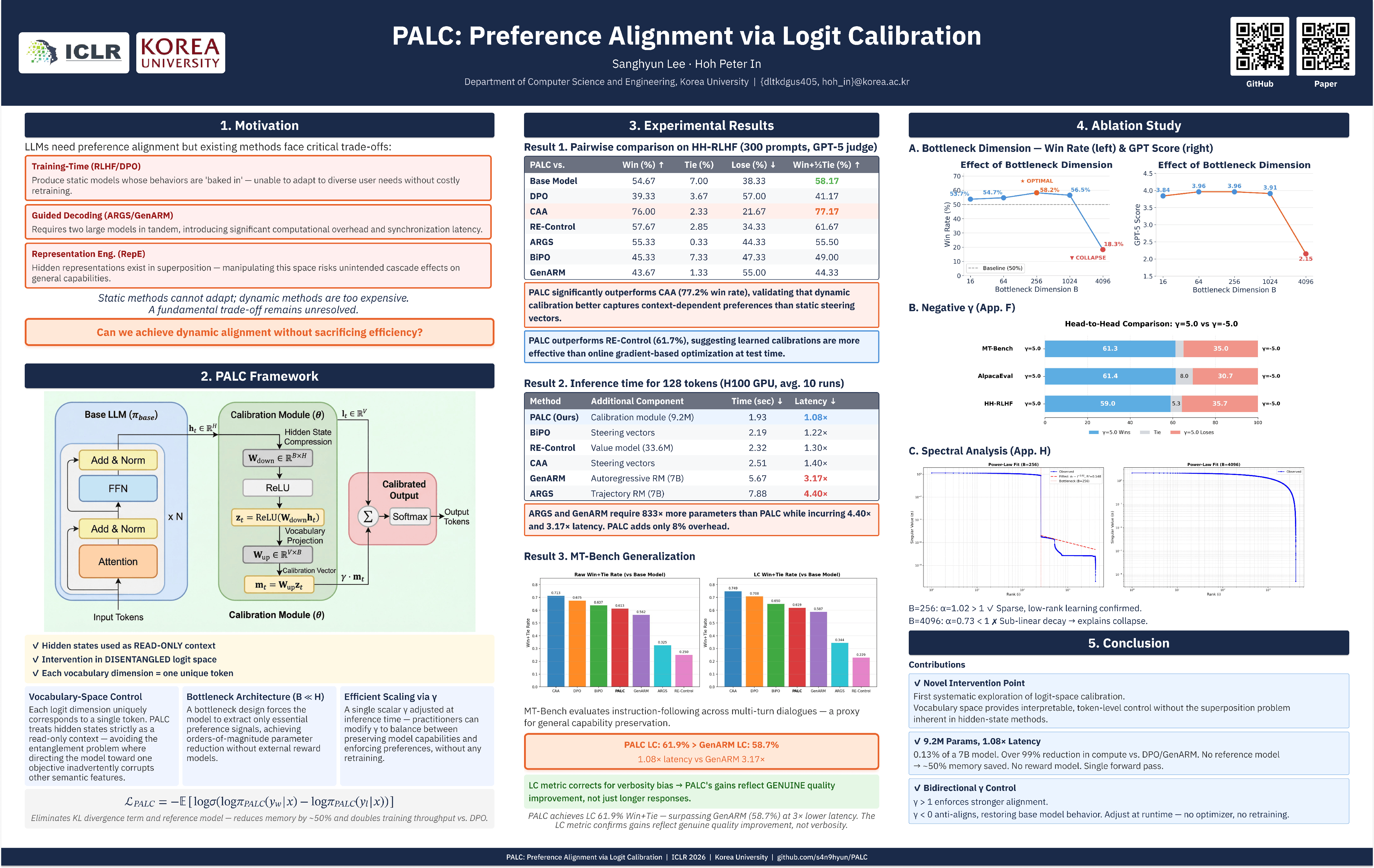
Aligning Large Language Models with human preferences typically requires computationally intensive training or complex reward architectures. We introduce PALC (Preference Alignment via Logit Calibration), a parameter-efficient framework that achieves test-time alignment through a novel intervention strategy: direct calibration in vocabulary space. Unlike existing methods that manipulate entangled hidden representations or rely on external reward models, PALC operates at the logit layer where each dimension corresponds to a distinct token, providing interpretable and efficient control. Our approach employs a bottleneck architecture that learns to compress the base model's hidden states and generate position-dependent calibration vectors, requiring only a fraction of the base model's parameters. Through this design, PALC sidesteps the superposition problem inherent in representation engineering while eliminating the computational overhead of guided decoding methods. A single scaling factor enables runtime adjustment of alignment strength without retraining, allowing practitioners to balance between preserving model capabilities and enforcing preferences. Experiments demonstrate that PALC outperforms most test-time alignment methods while maintaining near-baseline inference speed. Our ablations reveal that human preferences concentrate on surprisingly low-dimensional manifolds, validating our architectural choices. By establishing vocabulary-space intervention as an effective alignment paradigm, PALC makes preference alignment accessible for resource-constrained deployments where traditional methods are infeasible, opening new avenues for scalable and adaptive AI alignment.