
From Seeing to Experiencing: Scaling Navigation Foundation Models with Reinforcement Learning
Abstract
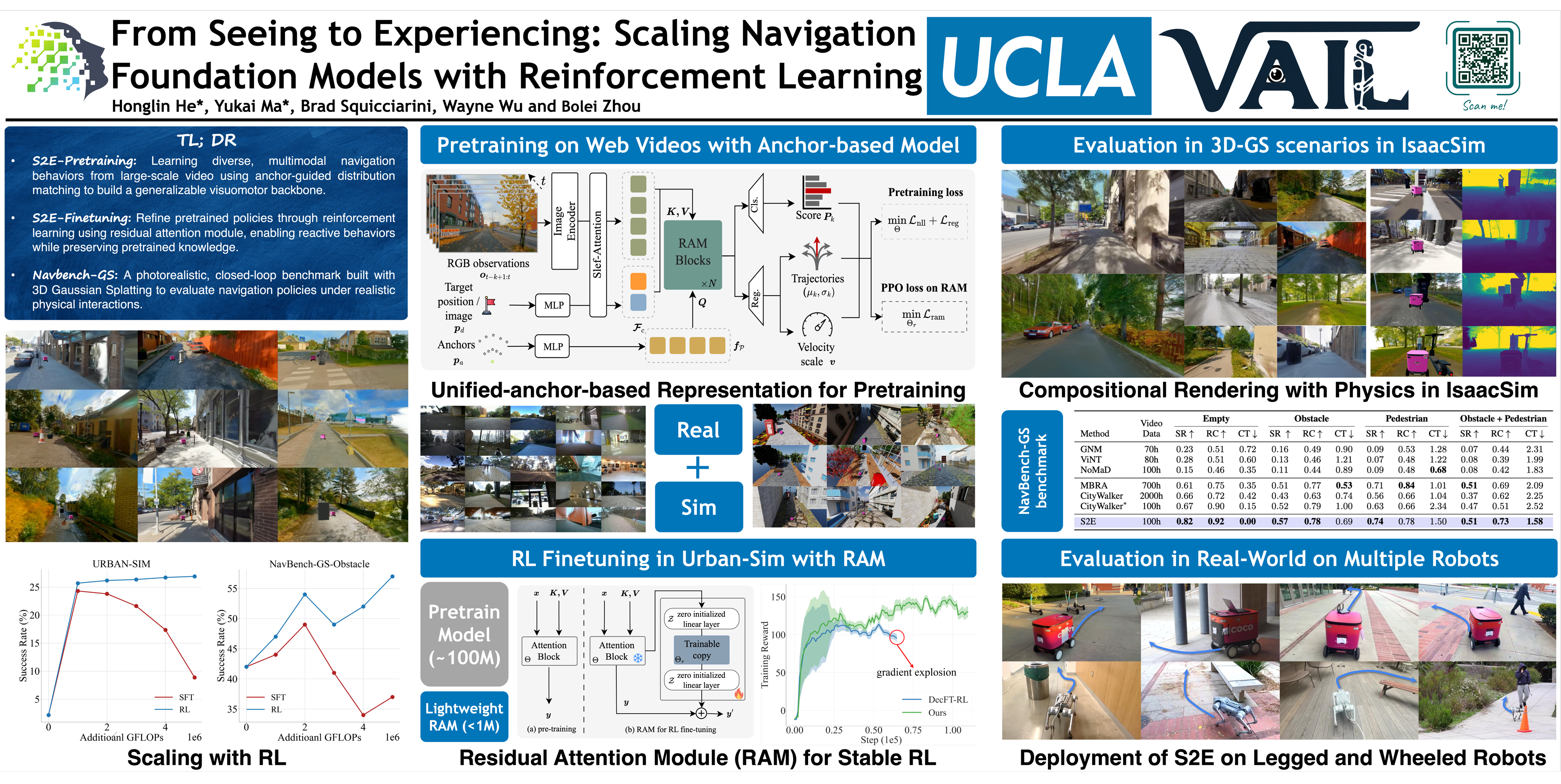
Navigation foundation models trained on massive web-scale data enable agents to generalize across diverse environments and embodiments. However, these models, which are trained solely on offline data, often lack the capacity to reason about the consequences of their actions or adapt through counterfactual understanding. They thus face significant limitations in the real-world urban navigation where interactive and safe behaviors, such as avoiding obstacles and moving pedestrians, are critical. To tackle these challenges, we introduce the Seeing-to-Experiencing (S2E) learning framework to scale the capability of navigation foundation models with reinforcement learning. S2E combines the strengths of pre-training on offline videos and post-training through reinforcement learning. It maintains the model's generalizability acquired from large-scale real-world videos while enhancing its interactivity through reinforcement learning in simulation environments. Specifically, we introduce two innovations: 1) an Anchor-Guided Distribution Matching strategy for offline pretraining, which stabilizes learning and models diverse motion patterns through anchor-based supervision; and 2) a Residual-Attention Module for reinforcement learning, which obtains reactive behaviors from simulation environments without erasing the model’s pretrained knowledge. Moreover, we establish a comprehensive end-to-end evaluation benchmark, NavBench-GS, built on photorealistic 3D Gaussian Splatting reconstructions of real-world scenes that incorporate physical interactions. It can systematically assess the generalizability and safety of navigation foundation models.