
Spatially Informed Autoencoders for Interpretable Visual Representation Learning
Abstract
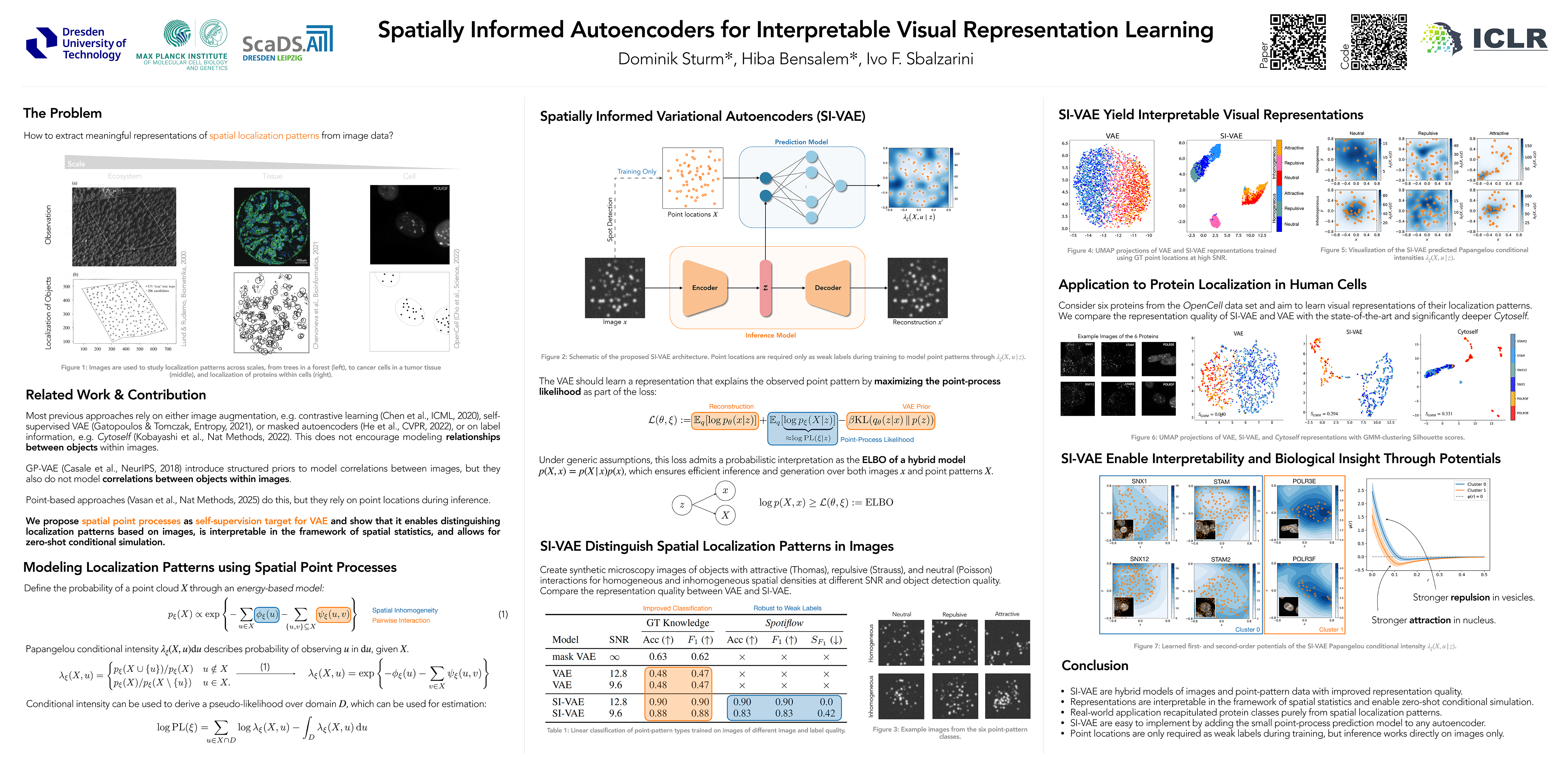
We introduce spatially informed variational autoencoders (SI-VAE) as self-supervised deep-learning models that use stochastic point processes to predict spatial organization patterns from images. Existing approaches to learning visual representations based on variational autoencoders (VAE) struggle to capture spatial correlations between objects or events, focusing instead on pixel intensities. We address this limitation by incorporating a point-process likelihood, derived from the Papangelou conditional intensity, as a self-supervision target. This results in a hybrid model that learns statistically interpretable representations of spatial localization patterns and enables zero-shot conditional simulation directly from images. Experiments with synthetic images show that SI-VAE improve the classification accuracy of attractive, repulsive, and uncorrelated point patterns from 48% (VAE) to over 80% in the worst case and 90% in the best case, while generalizing to unseen data. We apply SI-VAE to a real-world microscopy data set, demonstrating its use for studying the spatial organization of proteins in human cells and for using the representations in downstream statistical analysis.