
Antibody design using preference optimization and structural inference
Abstract
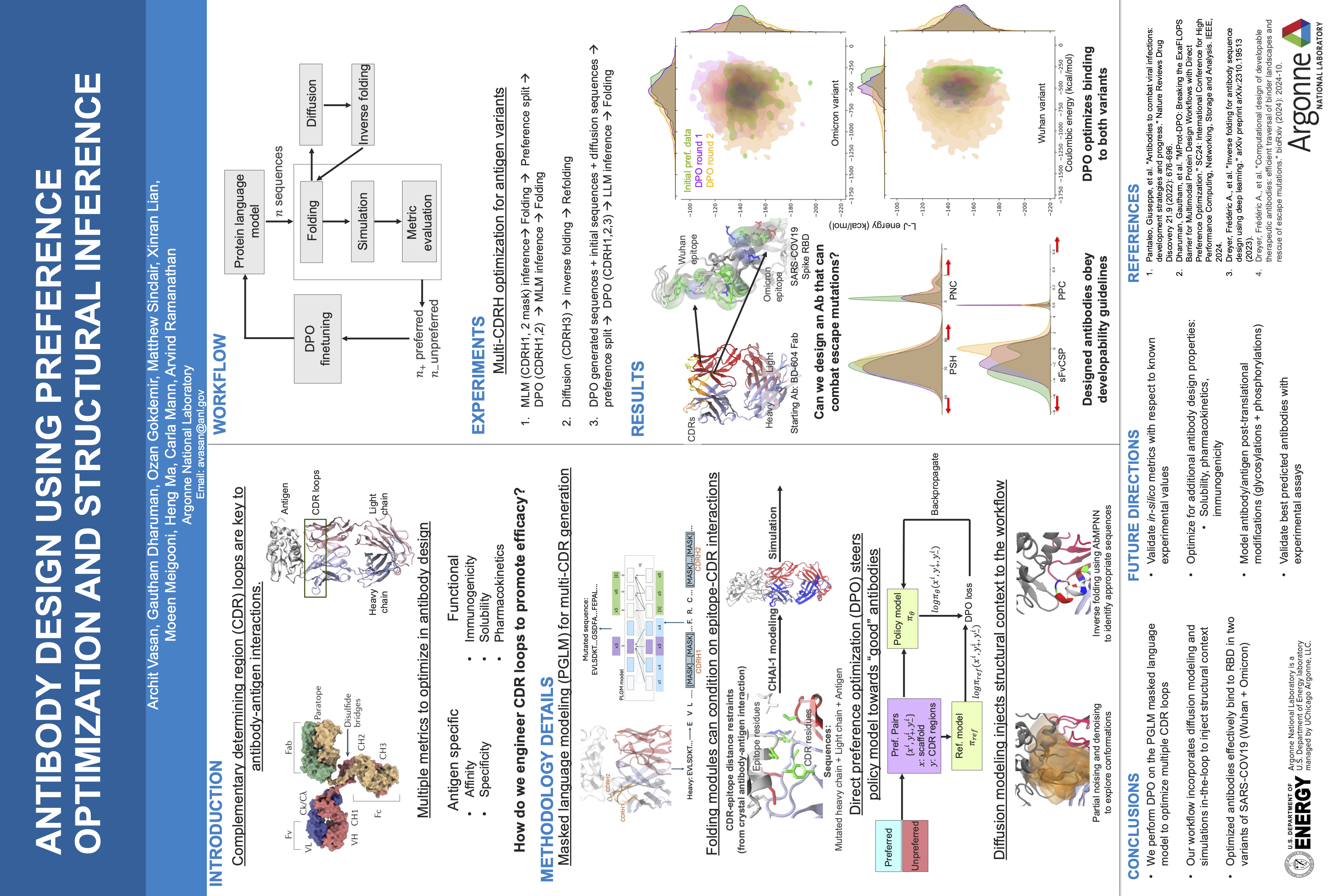
Antibodies offer several advantages in therapeutic design, including high specificity to targets, reduced off-target effects, immune system engagement, and the ability to bind traditionally undruggable proteins. To harness these benefits, we propose an antibody design method that integrates large language models (LLMs), preference optimization, diffusion modeling, and molecular dynamics simulations. Our approach begins by fine-tuning an LLM on complementarity-determining region (CDR) sequences, generating new CDR sequences, and folding antibodies with antigen scaffolds. We then apply diffusion models to refine CDR backbones, followed by inverse folding to generate new amino acid sequences. These redesigned antibodies undergo molecular dynamics simulations to evaluate binding affinity, and preference data is used to iteratively improve the LLM through direct preference optimization.This method has been applied to lysozyme, where it produced antibodies with greater predicted binding affinity than native counterparts. Future directions include extending this approach to antigens that adopt multiple conformations and experimentally validating the designed antibodies. Ultimately, this framework leverages artificial intelligence and high-performance computing to accelerate the discovery of clinically relevant antibody candidates.